(",)

LoveHateFollowers

Tuesday, May 20, 2014

SEDA Malaysia: Low Energy Office (SEDA LEO), Sabah

Source: www.seda.gov.my    
    Sustainable Energy Development Authority Malaysia or SEDA Malaysia is serious about renewable energy and energy efficiency effort in the country. As the implementer of Feed-in Tariff program for Renewable Energy Development in Malaysia, SEDA has opened the first retrofitted energy efficient government office in Sabah which demonstrates integration of energy efficient measures and optimization to achieve cost-effective energy efficient solutions. Located at Likas Square Commercial Centre, Kota Kinabalu, Sabah this office has the potential to achieve more than 40% energy savings on lighting and equipment compared to conventional air-conditioned office building.

Source: www.seda.gov.my
    With a space of 1,182 square feet, the office known as SEDA Malaysia Low Energy Office (SEDA LEO) becomes the trendsetter of energy efficiency prospects in Eastern Malaysia. SEDA LEO is the exhibition platform for best practices and appropriate technologies in efficient energy use and it aims to become a reference for state government agencies, developers, contractors and building services professionals to design energy efficient buildings. SEDA LEO represents SEDA Malaysia’s commitment and continuous effort to push for sustainable energy sector especially with a wider segment in Sabah. SEDA Malaysia is committed to lead the way by providing examples on sustainable energy practices and to share the knowledge on energy efficiency concept for building services in Sabah. Here are the energy efficient features of SEDA LEO :

Source: www.seda.gov.my
1) Building Orientation:
-The office has a correct orientation as the windows are facing north and there is low heat gained from the sun light.

2) Natural Day Lighting and Glazing:
-Large window area and the glazing is clear glass which allows ample diffuse daylight into the building and serves as a primary source of lighting to save energy.
-Daylight is also much cooler than the direct sunlight, thereby avoiding increased cooling load and avoiding excessive glare.

3) Energy Efficient Interior Design:
-The interior of the office is painted with light color which helps to promote better reflection of light and less dependency on artificial lighting.
-Work desk orientation is parallel with the windows to avoid or minimize glare problems.

Source: www.seda.gov.my

4) Space Planning:
-Frequently-used working area such as officer’s work stations are located near the windows to fully utilized daylight and save energy.
-Areas such as meeting room, store and ICT services room are positioned at the inner part of the office.
-The layout provides more conducive environment to improve motivation and reduce stress at the same time.

5) Efficient Distribution of Cooling System:
-The ducting for distribution of cooling system was revamped in the office to prepare a balanced and efficient air conditioning distribution for the human comfort.

6) Energy Efficient Lighting System:
-High efficiency lighting T5 fluorescent tube with electronic ballast and LED lights are used with innovative lighting control.
-Lighting intensity level design is according to MS1525:2007 Code of Practise Use of Energy Efficiency & Renewable Energy for Non-residential Buildings (300-400 lux level for office).
-Lighting power density is within 5-6 Watt compared with conventional design 12-20 Watt.

Source: www.seda.gov.my
7) Intelligent Lighting System Controller:
-Combination of photocell sensors and occupancy sensor automatically control lighting switches when areas are not occupied.
-Day light photocell sensors (day light system) is deployed at the perimeter of the room to control switching of the light fitting for the purpose of energy savings.

8) Energy Efficient Office Equipments:
-The equipments used at SEDA LEO provide energy saving and improved working condition as compared to conventional equipments.
-Some examples are 5-star rated energy efficient appliances such as laptops to reduce electricity consumption and operational cost of SEDA LEO.

9) Online Energy and Power Monitoring System:
-The system provides a platform to monitor and record the total energy consumption of lighting system, office appliances and general equipment.
-The total energy recorded is displayed in real-time and in situ, additionally these data can be remotely accessed via the internet.

Source: www.seda.gov.my

10) Low Energy ICT Network System:
-The office fully deploys wireless network technology for integrated low energy ICT system.

    Estimated annual energy saving is 9,660 kWh which accounted about RM 3,800 annually with payback period of 3.4 years can be gained by SEDA LEO. However, additional 6.8% of the capital cost of retrofitting the office is required but the contribution to the environment is truly priceless. You can visit SEDA LEO office and experience these features yourself and perhaps, you can talk to the person-in charge as well if you are interested in retrofitting your own energy efficient building. Let us revisit SEDA Malaysia roles in implementing the FiT-in Tariff as part of the sustainable energy and energy efficiency effort in the country as taken from www.seda.gov.my.
Source: www.seda.gov.my
    Malaysia’s Feed-in Tariff system requires the Distribution Licensees (DLs) such as Tenaga Nasional Berhad and NUR Distribution Sdn. Bhd. (NUR) with this year’s addition of Sabah Electricity Sdn. Bhd (SESB) to buy electricity from independent renewable energy producers. FiT rates are set by SEDA Malaysia with approval from KeTTHA.By having access to the grid and setting a favorable price per unit of renewable energy, the FiT mechanism also ensures that renewable energy becomes a viable and sound long-term investment for companies, industries and individuals. This can happen  easily if consumers are registered under SEDA Malaysia as one of the producers of renewable energy through solar PV, small hydro power, biomass and biogas at their homes or private lands.

    The Cabinet has also agreed for the surcharge on consumers’ electricity bills that has been gazetted and collected from consumers. 1% surcharge is needed to achieve the target capacity of renewable energy in the long run. As of 2013, 1% surcharge was imposed on all electricity customers and domestic electricity consumers are obliged to contribute to the surcharge only if their monthly electricity consumption exceeds 300 kWh or RM 77 a month.
Source: www.nusolar.com.my/images/leftpic-fitseda.jpg
    This money is channelled into the Renewable Energy Fund (KWTBB) and administered by SEDA Malaysia to pay the premium Feed-in Tariff rate to those producers who generate electricity from renewable resources at homes or in industrial companies. However, as of January 2014, this surcharge has been increased to  1.6 % . This increase will also affect the consumers in Sabah and Wilayah Persekutuan Labuan as they are charged with 1.6% of their electricity bills for the first time from RM69.00 above. Please refer to www.seda.gov.my for more news and information about this tariff. Thank you everyone for reading, take care and God bless you!

Monday, March 31, 2014

SEDA Malaysia: Feed-in Tariff Application

Source: www.seda.gov.my
Hello everyone! Are you excited about renewable energy and energy efficiency effort in Malaysia? I am thrilled to see the positive growth that Malaysia has undertaken in order to avoid being solely dependent on fossil fuels to generate electricity. Let us get to know the steps for interested personnel in the country who would like to generate renewable energy and sell it out to Distribution Licencees (DLs) such as TNB, Nur and SESB in order to generate passive income. SEDA Malaysia is the implementer of Feed-in Tariff program for development of renewable energy in Malaysia.
Source: www.seda.gov.my
First of all, individuals or corporate sectors that are interested in installing solar PV system must contact PV service provider and get the provider to do the installation and help you apply for the Feed-in Approval. Directory for PV service providers can be obtained from www.seda.gov.my > Directory > click on RE Industry Directory. There are over 100 PV service providers in Malaysia ready to assist you so be sure to survey for price comparison and check on their past projects and experiences in this industry. Proven track record, accountability and reliability are very important indicators to ensure the quality and durability of the PV system installation.
Source: weirdbella.blogspot.com/
There are certain criteria for the individuals interested in applying for the Feed-in Tariff mechanism:
-Malaysian citizen aged 21 years and above
-Ownership of the landed property with evidence to prove relationship between leaser and leasee
-Each individual is limited to two applications
-Each application should not exceed 12kW installation capacity and must have different address.

Complete the eligible criteria found in www.seda.gov.my under Feed-in Tariff > How to Become a Feed-in Tariff Approval Holder > Solar PV Installations <72kw b="">If you are interested, here is what you need to do:


There are two registration stages for Feed-in Approval application and they are:

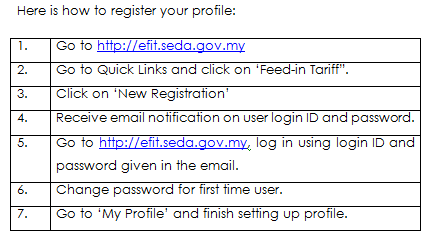
1) Profile registration:
-A copy of MyCard

2) Project registration:
- Copy of documents proving the Applicant’s ownership of the site, or other conditional or unconditional rights.
-Copy of Land Title of the landed property.
- Copy of fee payment receipt.
-Copy of system Engineering Drawing prepared by your appointed Service Provider.
-Copy of wireman certificate(s) issued by the Energy Commission to the Qualified Person(s) prepared by the Service Provider.
-Copy of certificate in solar photovoltaic system design from any institution recognized by the authority, also provided by the Service Provider.


There are some administration fees imposed upon application. Total application fee for a 4 kW installation capacities is RM 310 for application made through manual submission and RM 200 for application through electronic delivery. Payment can be made through online transfer or cheque payable to SEDA Malaysia’s account.

Malaysia’s Feed-in Tariff system requires the Distribution Licensees (DLs) such as Tenaga Nasional Berhad and NUR Distribution Sdn. Bhd. (NUR) with this year’s addition of Sabah Electricity Sdn. Bhd (SESB) to buy from renewable energy producers the electricity produced by them. FiT rates are set by SEDA Malaysia with approval from KeTTHA to pay for the renewable energy supplied to the electricity grid for a specific duration.
By having access to the grid and setting a favorable price per unit of renewable energy, the FiT mechanism also ensures that renewable energy becomes a viable and sound long-term investment for companies, industries and individuals. This can happen very easily if consumers are registered under SEDA Malaysia as one of the producers of renewable energy through solar panels, small hydro power, biomass and biogas at their homes or private lands.
Source: ahmadfaizal.com/2013/11/27/apa-kaitan-feed-in-tariff-fit-dan-fund-dengan-bil-elektrik-rumah-kita/
The Cabinet has also agreed for the surcharge on consumers’ electricity bills that has been gazetted and collected from consumers. 1% surcharge is needed to achieve the target capacity of renewable energy in the long run. As of 2013, 1% surcharge was imposed on all electricity customers and domestic electricity consumers are obliged to contribute to the surcharge only if their monthly electricity consumption exceeds 300 kWh or RM 77 a month.
RE fund 1 peratus Apa kaitan Feed in Tariff (FiT) dan RE Fund dengan bil elektrik rumah kita?
Source: ahmadfaizal.com/2013/11/27/apa-kaitan-feed-in-tariff-fit-dan-fund-dengan-bil-elektrik-rumah-kita/
This money is channelled into the Renewable Energy Fund and administered by SEDA Malaysia to pay the premium Feed-in Tariff rate to those producers who generate electricity from renewable resources at homes or in industrial companies. However, as of January 2014, this surcharge increases by 0.6% to be 1.6 % for current electricity users. This increase will also affect the consumers in Sabah and Wilayah Persekutuan Labuan as they are charged with 1.6% of their electricity bills for the first time. Please refer to www.seda.gov.my for more news and information about this tariff. Take care and God bless, I will see you later!

SEDA Malaysia: Unlocking the Potential of Renewable Energy

Source: www.fluorescentsquid.com/ver1/
Hello everyone and welcome to http://azhamvosovic.blogspot.com where I will keep all of you updated with the information required for renewable energy and energy efficiency effort in Malaysia. The Ministry of Energy, Green Technology and Water (KeTTHA) together with Sustainable Energy Development Authority (SEDA Malaysia) have worked hand in hand to promote the awareness and raise public concerns on the needs to discover the potential of renewable energy and the benefits of energy efficiency in the country.
Source: thinkprogress.org/climate/2013/03/29/1791811/bombshell-imf-study-united-sates-is-worlds-number-one-fossil-fuel-subsidizer/
Renewable energy & sustainable measures are important to the country because depleting fossil fuel sources such as oil, can last for only 11.8 years and natural gas for another 39.4 years. Energy is the cornerstone of any country’s economy thus energy security is a very important issue which must be managed well so renewable energy will eventually become the answer to our quest for greener energy growth and secure our economy development in the long run.
Source: ladfeamir.com/2013/12/27/pentingnya-feed-in-tariff-fit-di-malaysia/
Renewable energy provides an alternative to fossil fuels that can reduce environmental issues, creates more job opportunities as well as a long-term, secure and locally-produced energy supply to fuel the economy. Feed-in Tariff (FiT) is among the most effective policy instrument to encourage the development of renewable energy in a country. A Feed-in Tariff is simply a guaranteed price established for anyone who wants to sell renewable electricity to the grid and acts as a guarantee that they will have access to the grid to do so. The tariff is set so that a modest profit is ensured and unleashes the collective capital resources of the entire province, state or country to be part of the transition to renewable energy.
Source: www.viridis-asia.net/what-is-feed-in-tariff-fit.html
The Malaysian government has approved the implementation of Feed-in Tariff Mechanism in Malaysia when Renewable Energy Act 2011 (Act 725) was enforced on December 1st 2011 aimed to promote the deployment of renewable energy such as photovoltaic, biomass, biogas and small hydro in the country’s energy mix. SEDA Malaysia is the implementer of Feed-in Tariff program for development of renewable energy in Malaysia.
Source: ohcikgu.com/2013/10/29/seda-malaysia-open-day-blogger-workshop-2013/
Malaysia’s Feed-in Tariff (FiT) system requires the Distribution Licensees (DLs) such as Tenaga Nasional Berhad and NUR Distribution Sdn. Bhd. (NUR) with this year’s addition of Sabah Electricity Sdn. Bhd (SESB) to buy from renewable energy producers the electricity produced by them. FiT rates are set by SEDA Malaysia with approval from KeTTHA to pay for the renewable energy supplied to the electricity grid for a specific duration.
Source: www.solarmalaysia.com.my/aboutfit.php
By having access to the grid and setting a favorable price per unit of renewable energy, the FiT mechanism also ensures that renewable energy becomes a viable and sound long-term investment for companies, industries and individuals. This can happen if consumers are registered under SEDA Malaysia as one of the producers of renewable energy through solar panels, small hydro power, biomass and biogas at their homes or private lands.
Source: www.fit-seda-malaysia.com/Homeowners1.html
The basic concept of FiT mechanism is that the Distribution Licencees (DLs) pay the Feed-in Approval Holder (FiAH) for renewable energy that is generated and supplied to electricity grid on a premium tariff. A meter will be installed to record the amount of renewable energy produced by the system and passed to the main electricity grid. The energy generated from both conventional and renewable resources will be distributed to all electricity consumers as usual and DLs will credit the payment of the total electricity generated and supplied into the FiAH’s bank account. DLs will claim the money used to pay FiAH from the Renewable Energy Fund and that is actually the collection of 1.6% contribution from electricity consumers’ monthly bill.
Source: renewablekinabalu.blogspot.com/2012/11/malaysia-solar-energy-feed-in-tariff_12.html

The Cabinet has also agreed for the surcharge on consumers’ electricity bills that has been gazetted and collected from consumers. 1% surcharge is needed to achieve the target capacity of renewable energy in the long run. As of 2013, 1% surcharge was imposed on all electricity customers and domestic electricity consumers are obliged to contribute to the surcharge only if their monthly electricity consumption exceeds 300 kWh or RM 77 a month.
Source: www.seda.gov.my
This money is channelled into the Renewable Energy Fund and administered by SEDA Malaysia to pay the premium Feed-in Tariff rate to those producers who generate electricity from renewable resources at homes or in industrial companies. However, as of January 2014, this surcharge increases by 0.6% to be 1.6 % for current electricity users. This increase will also affect the consumers in Sabah and Wilayah Persekutuan Labuan as they are charged with 1.6% of their electricity bills for the first time. Please refer to www.seda.gov.my for more news and information about this tariff.
Source: www.solarmalaysia.com.my/aboutfit.php
The most common ways to generate renewable energy is by installing solar photovoltaic modules (solar PV) as the sun produces an abundant source of clean energy. This energy will then be converted into electricity by using solar PV technology that will help to reduce carbon footprint and provide a source of passive income through payments from the feed-in tariff. Before investing in a solar PV system, you need to check the following:

-Is the roof tilting less than 15 degrees?
Solar PV modules need maximum exposure to the sun and the roof should not tilt more than 15 degrees for countries lying along the equator as PV can lose nearly half of its potential energy yield.

-Will trees or buildings cast a shadow over the solar PV modules?
Parts of a PV module should not be under the shade as the amount of electricity generated will be reduced.
  
-Is your roof structurally sound?
It needs to take the extra weight of the solar PV modules together with the mounting structure.


Source: www.solarpowerbuzzmedia.com/
Before installation, make sure that you are registered with SEDA Malaysia and secure the feed-in tariff quota. FiT rate also depends on the capacity of your PV system and the year when the system achieves commercial operation. You can get the latest FiT and bonus rate at www.seda.gov.my and do not forget to apply for the quota if you are interested. Take care and God bless.

("-")